Development
This page covers the repository layout, the local development stack, the tests, the documentation build, the CI workflows and the release procedure.
Repository layout
| Path | Content |
|---|---|
netbox_opentelemetry_plugin/ |
The plugin package. All OpenTelemetry SDK imports live in otel.py. |
tests/ |
Unit tests (pytest). tests/e2e/ holds the end-to-end tests that run against the dev stack. |
tests_netbox/ |
Integration tests that run inside NetBox with manage.py test. |
dev/ |
Docker compose dev stack: Dockerfile, docker-compose.yml, NetBox plugin configuration, Collector configuration, environment files and helper scripts. |
docs/ |
This documentation, built with Zensical from mkdocs.yml. |
.github/workflows/ |
CI, release and documentation workflows. |
Requirements: Python 3.12 or later, uv, Docker with the compose plugin, and make.
Dev stack
The stack is based on the netbox-docker image, with the plugin installed in editable mode and its source bind-mounted into the containers. Code changes apply after a container restart.
| Command | Starts |
|---|---|
make dev |
NetBox on Granian, the RQ worker, Postgres, two Valkey instances, the Collector and a webhook sink. |
make dev-gunicorn |
The same, plus NetBox on gunicorn with --preload. |
make dev-uwsgi |
The same, plus NetBox on uWSGI (pyuwsgi, master mode) behind nginx, laid out like NetBox's contrib/uwsgi.ini: uWSGI listens on a uwsgi-protocol socket and nginx forwards to it with uwsgi_pass. |
make dev-ui |
The same as make dev, plus Grafana with Loki, Tempo and Prometheus (profile ui, see Grafana UI). |
make down |
Stops every service of all profiles. |
To run all three web servers at once, as the scheduled CI job does:
docker compose -f dev/docker-compose.yml --profile gunicorn --profile uwsgi up -d --build --wait --wait-timeout 600
Ports on the host:
| Port | Service |
|---|---|
| 8000 | NetBox on Granian |
| 8001 | NetBox on gunicorn (profile gunicorn) |
| 8002 | NetBox on uWSGI, through nginx (profile uwsgi) |
| 3000 | Grafana (profile ui), on 127.0.0.1 only |
| 4317 | Collector, OTLP gRPC |
| 4318 | Collector, OTLP HTTP |
The NetBox superuser is admin with password admin.
The Collector writes everything it receives to dev/data/collector/ (logs.json, traces.json, metrics.json, one JSON document per line) and prints it with the debug exporter. make logs-collector follows the Collector's output. The files grow without limit; delete them while the stack is stopped if they get too large.
Grafana UI
The ui profile adds grafana/otel-lgtm, one container with Grafana, Loki (logs), Tempo (traces) and Prometheus (metrics). The Collector then sends everything it receives to it over OTLP gRPC, in addition to the debug and file exporters, so the files in dev/data/collector/ and the e2e tests work the same with or without it.
make dev-ui                 # Granian, as make dev
make dev-gunicorn UI=1      # any dev target takes UI=1
make dev-uwsgi UI=1
The image is about 2.5 GB. Grafana is on http://localhost:3000, published on the loopback interface only, with anonymous access and the Admin role, so no login is needed. The admin user has the password admin. The data sources Loki, Tempo and Prometheus are provisioned by the image. NetBox telemetry has the service name netbox: in Explore, query Loki with {service_name="netbox"}, search Tempo for the service netbox, and query Prometheus for metrics such as http_server_request_duration_seconds_count. The image keeps its data inside the container, so it is lost when the container is recreated.
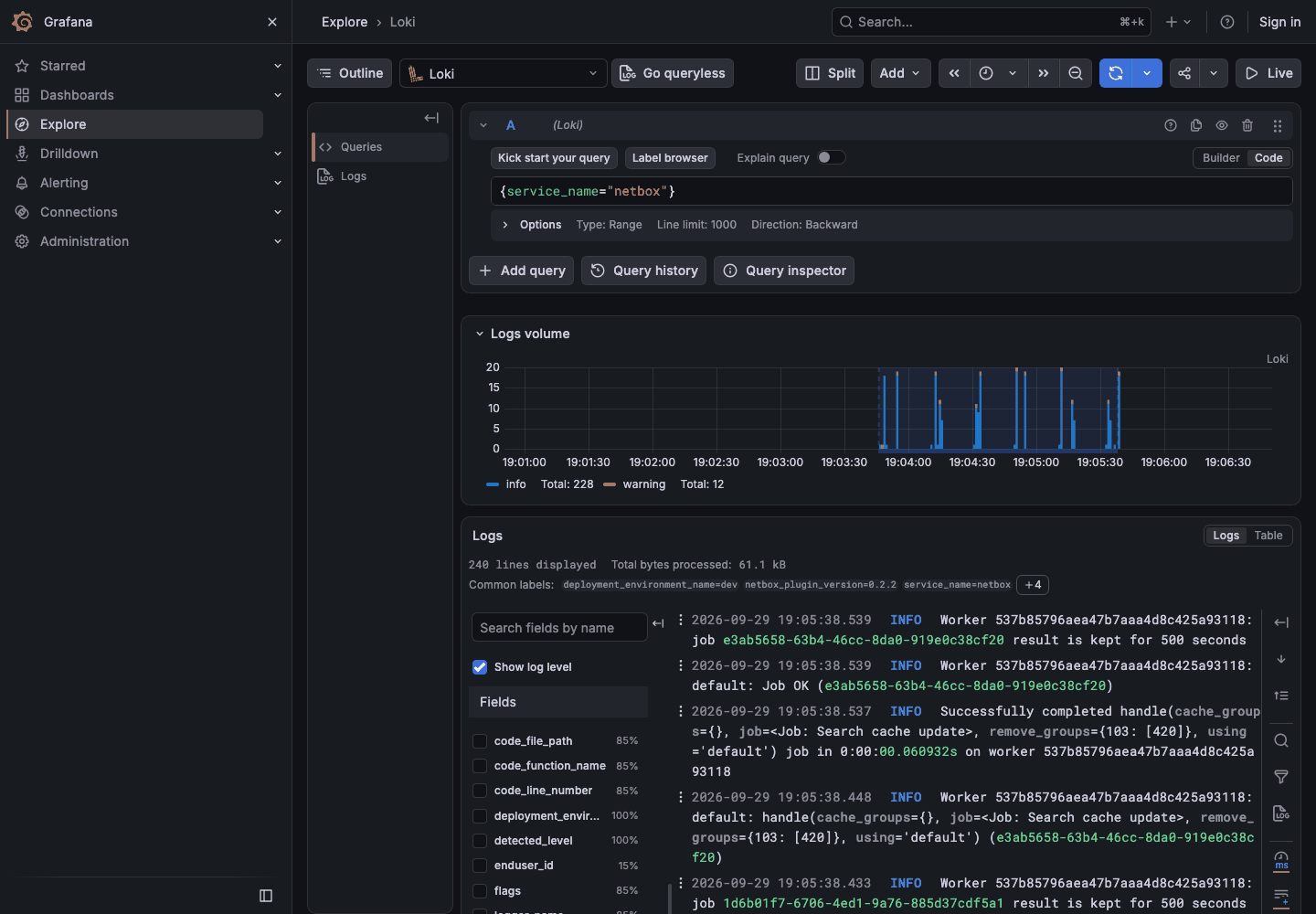
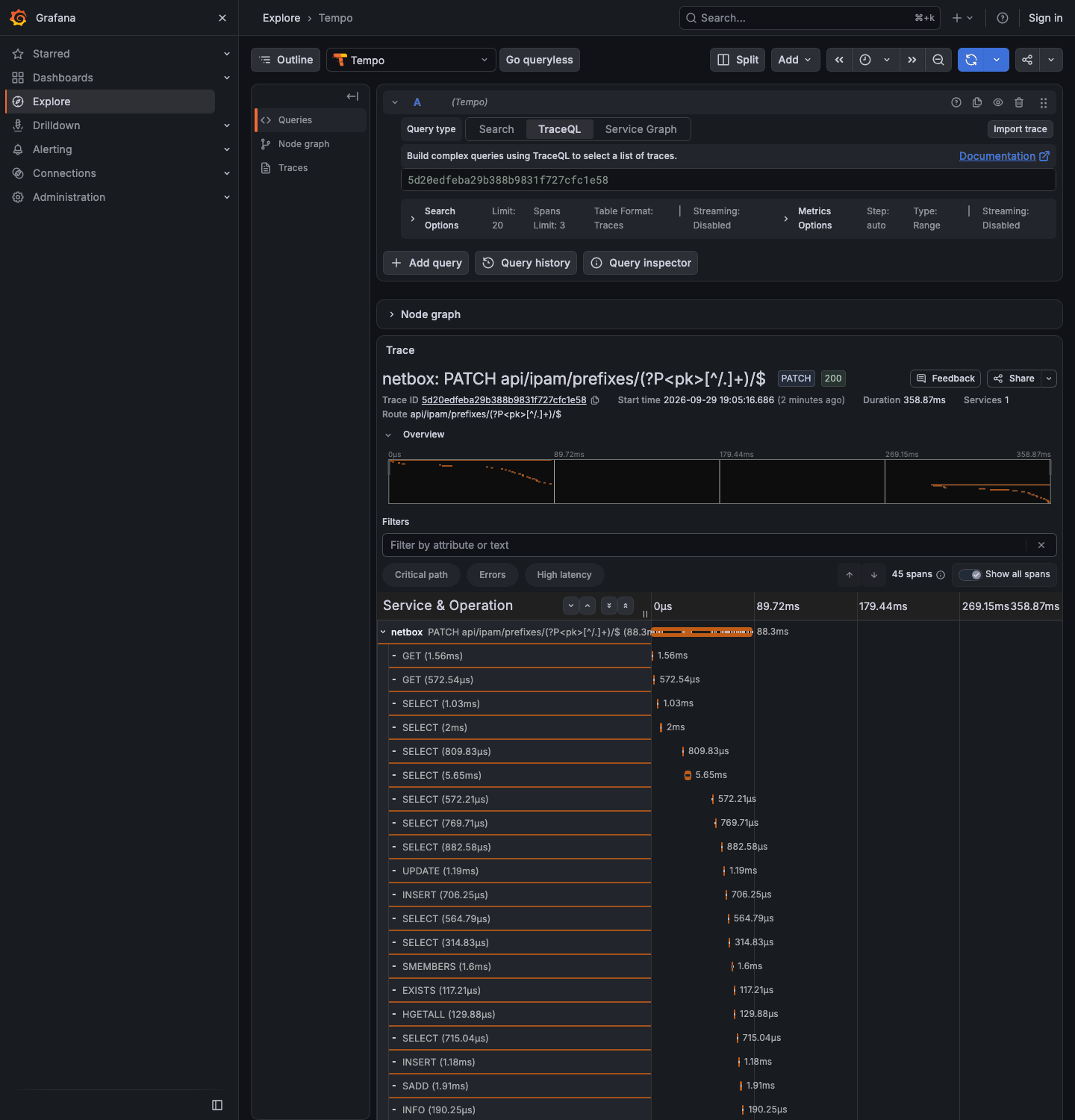
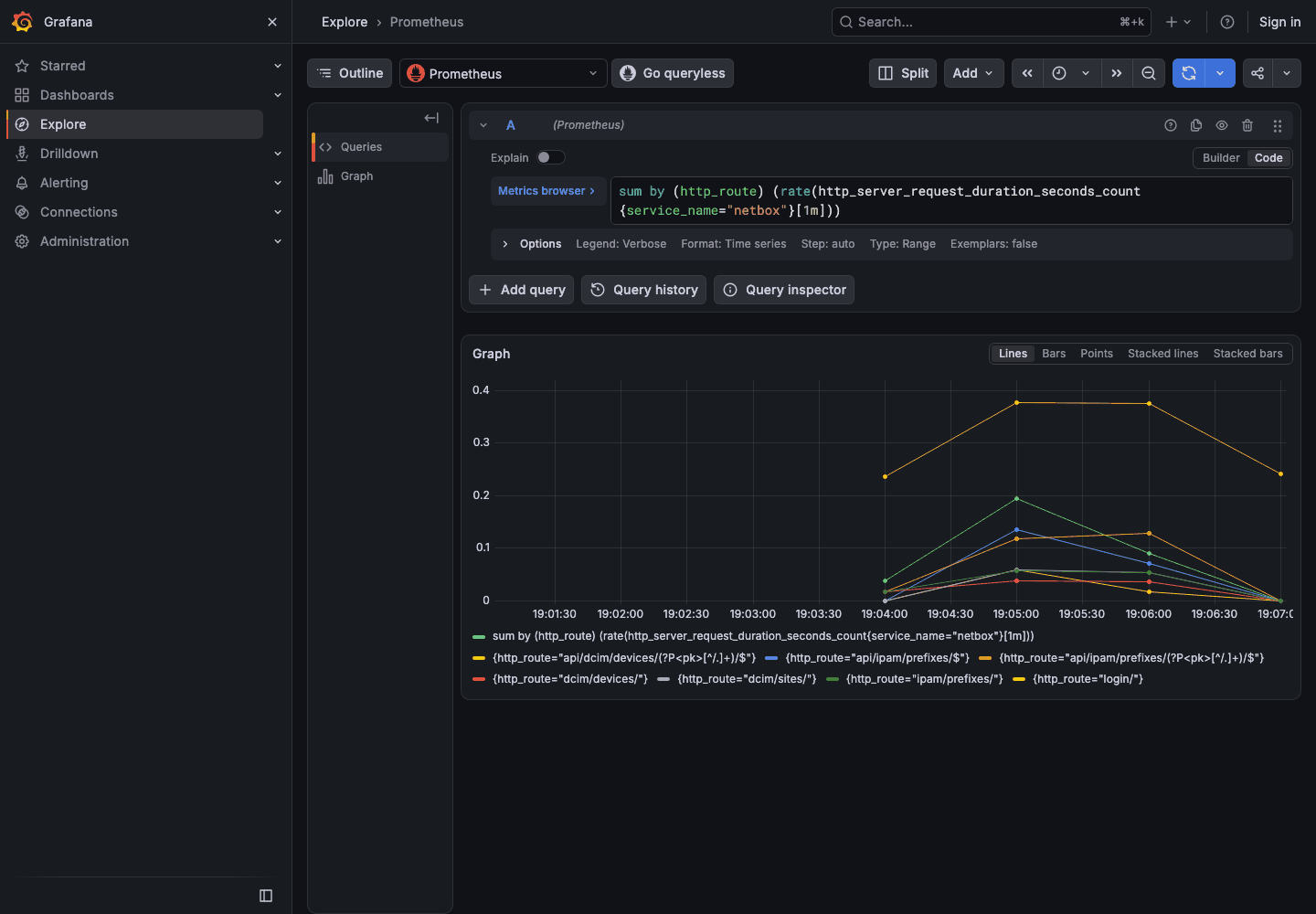
Selecting a Collector configuration is not something a compose profile can do, so the profile comes with an override file. make dev-ui runs:
docker compose -f dev/docker-compose.yml -f dev/docker-compose.ui.yml --profile ui up -d --build
dev/docker-compose.ui.yml starts the Collector with a second --config flag that loads dev/otelcol/ui.yaml over dev/otelcol/config.yaml. That overlay adds the otlp_grpc/lgtm exporter to the three pipelines. Without the override the Collector has no exporter pointing at otel-lgtm, so the default stack does not depend on it and logs no export errors when it is absent. Using the override without --profile ui fails at once with service "otel-collector" depends on undefined service "otel-lgtm". With --profile ui alone, Grafana starts but receives nothing.
Running make dev after make dev-ui recreates the Collector with the default configuration and leaves otel-lgtm running; make down stops it.
The Grafana, Loki, Tempo and Prometheus APIs can be queried through Grafana's data source proxy, without publishing more ports:
curl -sG 'http://localhost:3000/api/datasources/proxy/uid/prometheus/api/v1/query' \
  --data-urlencode 'query=count by (__name__) ({service_name="netbox"})'
curl -sG 'http://localhost:3000/api/datasources/proxy/uid/loki/loki/api/v1/query_range' \
  --data-urlencode 'query={service_name="netbox"}' --data-urlencode 'limit=5'
curl -s 'http://localhost:3000/api/datasources/proxy/uid/tempo/api/search?tags=service.name%3Dnetbox&limit=5'
Tests
| Command | What it runs |
|---|---|
make test |
Unit tests, with DeprecationWarning turned into errors. No stack needed. |
make test-netbox |
Integration tests in tests_netbox/, inside the running netbox container. |
make e2e |
End-to-end tests in tests/e2e/ against the running stack. The worker test covers each web server that is running and skips the ones that refuse the connection; a server that answers /login/ with anything but 200 fails the test. |
make lint |
ruff check and ruff format --check. |
make format |
Applies ruff fixes and formatting. |
The unit tests run on Python 3.12, 3.13 and 3.14 in CI. To run them locally with a given version:
UV_PYTHON=3.13 uv run pytest
Documentation
| Command | What it does |
|---|---|
make docs |
Builds the site into site/ with zensical build --strict. Zensical publishes every file under docs/, so the build runs on a staging copy (build/docs-src/) of the files git can see: files excluded through .gitignore or .git/info/exclude are never published. The target also fails if the output contains such files. |
make docs-serve |
Serves the working tree with live reload on http://localhost:8000, for local preview only (it includes locally excluded files). Stop the dev stack first, or pass another address with uv run --group docs zensical serve -a 127.0.0.1:8010. |
The documentation tools are in the docs dependency group of pyproject.toml; uv run --group docs installs them on first use.
CI
Three workflows live in .github/workflows/.
ci.yml runs on pushes to main, on pull requests, every night at 03:17 UTC and on manual dispatch.
| Job | What it checks |
|---|---|
lint |
ruff check and format check. |
unit |
Unit tests on Python 3.12, 3.13 and 3.14, with uv sync --locked so a stale uv.lock fails. |
docs |
make docs (zensical build --strict) with the locked documentation dependencies. |
netbox-load |
Installs NetBox from source with the plugin on Python 3.12, runs manage.py check, checks that the log handler is attached, and checks that a configuration without any endpoint starts and prints no endpoint configured. |
netbox-integration |
Runs tests_netbox/ with manage.py test against Postgres and Valkey service containers. |
e2e |
Nightly and on manual dispatch only. Starts the dev stack with all three web servers and runs tests/e2e/. On failure, the compose logs and the Collector output are uploaded as the e2e-logs artifact. |
GitHub disables scheduled workflows in a public repository after 60 days without repository activity. The nightly run then stops until the workflow is enabled again from the Actions tab, or with gh workflow enable ci.yml.
release.yml runs on tags matching v* and on manual dispatch. It builds the sdist and the wheel, runs twine check --strict and dev/scripts/check_dist.py (archive contents, and for a tag, that the tag equals v followed by the package version). For a tag it also checks that the tagged commit is on main. A tag push publishes to PyPI; a manual run publishes to TestPyPI only, whatever branch or tag it is started on. Both use trusted publishing (OIDC), so no API token is stored in the repository, and attestations are generated by default. ci.yml does not run on tags and release.yml does not run the tests, so a release relies on CI having passed on the tagged commit on main.
docs.yml runs on tags matching v* and on manual dispatch. It builds the documentation and deploys it to GitHub Pages. It is independent of release.yml: on a tag, the documentation can be deployed even if publishing to PyPI fails, and the other way round.
Updating OpenTelemetry
The OpenTelemetry packages are pinned in pyproject.toml (~= for the API, SDK and exporters, == for the instrumentations). The fork handling depends on how the SDK behaves in a forked child (see How it works), and two unit tests reach into private SDK attributes. On every bump of the SDK minor version:
- Update the pins and
uv.lock(uv lock), then runmake test. test_sdk_internals_used_by_the_fork_lock_test_were_reviewed_for_this_sdkintests/test_fork.pyfails until the next two steps are done. Its message names the SDK attribute paths in question.- Check that
test_fork_while_batch_worker_lock_is_heldstill runs rather than skips (uv run pytest tests/test_fork.py -rs). It holds the lock the SDK's log batch worker waits on, found through_batch_worker_condition. If the SDK moved that lock, update_batch_worker_conditionandBATCH_WORKER_CONDITION_PATH. Check the same fortest_grpc_exporters_are_rebuilt_in_forked_children_and_deliver, which reads the queues of the batch processors a forked child inherits, found through_batch_queues. If the SDK moved them, update_batch_queuesandBATCH_QUEUE_PATHS. - Set
REVIEWED_OTEL_SDKintests/test_fork.pyto the new minor version. - Check that the statements about the SDK in section 4.2 of
SPEC.mdstill hold: the SDK re-initialises its batch processors in a forked child and clears their queues, keeps the parent's Resource and shares the parent's exporter. The fork tests intests/test_fork.py, including the one with a real gRPC receiver, cover the plugin side of this.
Releasing
-
Set the new version in
netbox_opentelemetry_plugin/version.py. InCHANGELOG.md, move the entries from[Unreleased]under a new heading## [<version>] - YYYY-MM-DDand update the link references at the bottom of the file. If the supported NetBox range changes, update the compatibility table inREADME.mdand in the docs home page. Commit onmain. -
Check that everything passes locally:
make test lint docs dist -
First release only:
- Create the GitHub repository
thomaschristory/netbox-opentelemetry-pluginand push themainbranch. - In the repository settings, under Pages, set the source to "GitHub Actions".
- Create the environments
pypi,testpypiandgithub-pages, optionally with required reviewers. - In the
github-pagesenvironment, under "Deployment branches and tags", add a tag rulev*. With the Pages source set to "GitHub Actions", GitHub restricts this environment to the default branch, and a deployment from a tag is rejected without that rule. If you restrict thepypienvironment to selected branches and tags, add the samev*tag rule there. - On PyPI and on TestPyPI, under Account settings, Publishing, register a pending trusted publisher with project name
netbox-opentelemetry-plugin, ownerthomaschristory, repositorynetbox-opentelemetry-plugin, workflowrelease.yml, and environmentpypi(on PyPI) ortestpypi(on TestPyPI).
- Create the GitHub repository
-
Push
mainand wait for CI to pass on the release commit:git push origin main gh run list --workflow ci.yml --branch main --commit "$(git rev-parse HEAD)" --limit 1 gh run watch <run-id> --exit-statusOptionally, run the full CI including the
e2ejob onmainand wait for it the same way:gh workflow run ci.yml --ref mainOnly tag a commit that is on
mainand has a green CI run. The release workflow refuses a tag whose commit is not onmain. -
Optional dry run: run the
releaseworkflow manually onmain(gh workflow run release.yml --ref main, or from the Actions tab). It publishes to TestPyPI only. TestPyPI refuses a version it already has, so a second dry run needs a new version number. Then install the package into a scratch virtual environment:uv venv /tmp/release-check uv pip install --python /tmp/release-check/bin/python \ --index-url https://test.pypi.org/simple/ --extra-index-url https://pypi.org/simple/ \ netbox-opentelemetry-plugin==<version> -
Tag the release commit on
mainand push the tag:git tag -a v<version> -m "v<version>" git push origin v<version>The tag starts
release.yml, which checks, builds, and publishes to PyPI with attestations, anddocs.yml, which deploys the documentation. -
Create the GitHub release with the CHANGELOG section of the version as notes. Copy that section (without its heading) into a file, then:
gh release create v<version> --title v<version> --notes-file <notes-file>